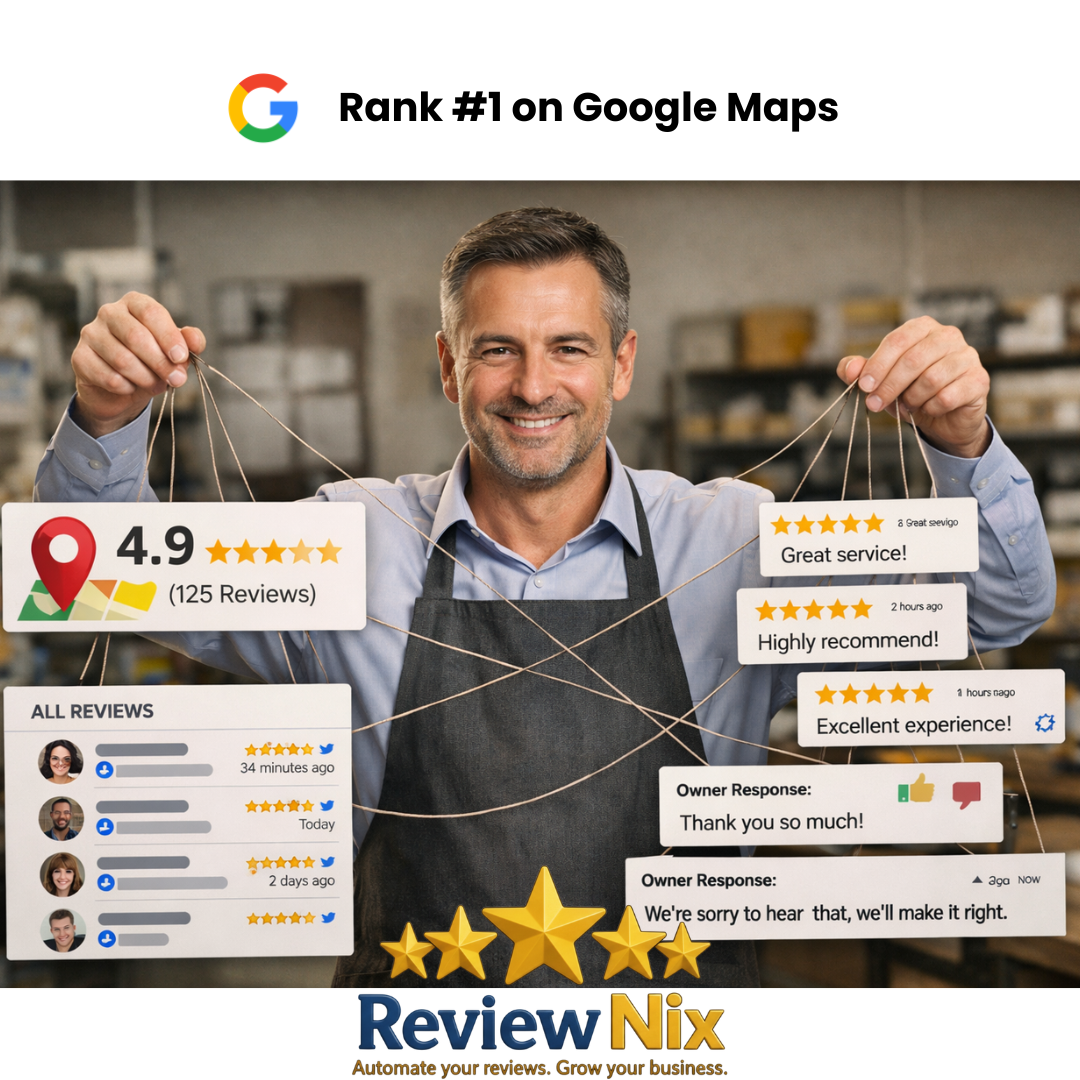

Google reviews matter because they influence what potential customers see, believe, and do before contacting a small business. They create visible social proof, support local discovery, reduce perceived risk, reveal service problems, and give owners a public channel to demonstrate responsiveness. They are not a guaranteed ranking or sales switch, but they are a high-impact trust signal at the exact moment a buyer is choosing.
The review is part of the buying experience
A potential customer may know nothing about a local plumber, dentist, salon, restaurant, attorney, or consultant. Search results often become the first storefront. The buyer sees the business name, category, proximity, photos, rating, number of reviews, recent comments, and owner responses before visiting the website or making a call. That visible evidence changes perceived risk.
For a small business, this matters more than it does for a famous national brand. Large companies arrive with built-in recognition. A local operator must earn trust in seconds. Reviews let previous customers explain what the business is like in language that feels more independent than advertising. A detailed review about punctuality, communication, cleanliness, or problem solving answers questions that a slogan cannot.
See what a prospect sees
Benchmark your rating, volume, recency, replies, and profile health before investing in more traffic.
Check your reputation score1. Reviews create social proof and reduce uncertainty
Buying from an unfamiliar local business involves uncertainty. Will the technician arrive? Will the clinic communicate clearly? Will the contractor honor the quote? Will the restaurant handle a busy evening well? Reviews do not eliminate uncertainty, but a pattern of genuine experiences helps the customer estimate it.
Volume, quality, detail, recency, and variety all influence credibility. Ten identical one-line comments can look less useful than a balanced body of specific reviews. A mix of praise and occasional criticism can appear more natural, especially when the owner replies constructively. Google itself notes that honest and balanced reviews can help potential customers decide.
The lesson is not “chase five stars at any cost.” The lesson is to create enough authentic, recent evidence that buyers can understand the real customer experience. That is why incentives, fake reviews, and review gating are strategically weak as well as non-compliant: they undermine the trust the review system is meant to create.
2. Reviews influence clicks, calls, directions, and website visits
Local search is often an action screen, not a research library. A user may compare three nearby businesses and choose which profile to open, call, visit, or request directions from. Reviews contribute to that comparison. A stronger and more current reputation can make the listing feel safer to explore.
Rating alone is not the whole story. Buyers also notice whether the reviews are recent, whether the comments match the service they need, and whether the owner responds. A 4.8 rating with fresh, detailed feedback may be more persuasive than a perfect rating based on very few old reviews. The conversion effect also depends on price, urgency, category, proximity, availability, and the quality of the profile and website.
Small businesses should therefore connect reputation metrics with profile actions. Track review recency and volume alongside calls, direction requests, website clicks, lead conversion, and booked work. Correlation does not prove that reviews caused every action, but the combined dashboard can reveal whether stronger reputation signals coincide with better commercial performance.
3. Reviews support local visibility, but do not guarantee rankings
Google Business Profile prominence is influenced by many factors. Reviews are widely understood as part of local reputation and prominence, but no business should treat them as a guaranteed shortcut to a specific position. Relevance, distance, category, business information, website authority, competition, and search context also matter.
Reviews contribute useful semantic context because customers naturally mention services, neighborhoods, outcomes, and experience details. Businesses should not script keywords for reviewers. A better approach is to provide a real service worth describing and make the feedback process easy. Natural language from genuine customers is more credible than forced phrasing.
Think of reviews as one part of a complete local presence: accurate profile data, correct categories, current hours, quality photos, useful services, a strong website, consistent citations, real reviews, and thoughtful replies. The business that improves the whole experience is more resilient than one that obsesses over a single metric.
Related: how AI Overviews use Google reviews for local businesses.
4. Recent reviews signal that the business is active
A large lifetime review total can be impressive, but recency answers a different question: is the business still operating at the same standard today? Staffing, ownership, processes, menus, service areas, and availability change. Fresh feedback gives prospects current evidence.
This is why a steady review cadence is usually more useful than occasional bursts. A business that asks consistently after completed service can build an ongoing stream that reflects current operations. A campaign that sends hundreds of requests at once and then goes silent is harder to manage and may produce an unnatural customer experience.
Measure the number of new reviews per month and the age of the most recent reviews. Compare that with completed customer transactions. The aim is not to pressure every person; it is to ensure the invitation is consistently delivered and easy to complete.
5. Owner responses become public proof of service quality
A response is written to one reviewer but read by many future customers. A useful reply demonstrates attention, tone, and accountability. Positive reviews deserve specific thanks. Critical reviews deserve calm acknowledgment, privacy awareness, and a clear next step. Defensive arguments, copy-paste responses, or disclosures of private customer information create additional risk.
Fast replies also close the operating loop. They force the business to monitor feedback and identify patterns. AI-assisted drafting can save time, but the response should still reflect the actual situation and the business’s voice. Sensitive complaints need human judgment.
ReviewNix helps prepare professional reply drafts and keep reputation activity visible in one workflow. The value is not simply “replying with AI.” It is reducing delay while maintaining a consistent standard for tone, escalation, and ownership.
Related: how to respond to Google reviews.
Build a repeatable reputation routine
Use the free playbook to organize profile setup, review requests, QR codes, reminders, and replies.
Get the free playbook6. Reviews are a free source of customer intelligence
Reviews contain operational data that surveys and internal meetings may miss. Customers describe what surprised them, what caused friction, and what they valued enough to mention publicly. Repeated references to punctuality, clarity, friendliness, billing, parking, cleanliness, speed, or follow-up reveal the real drivers of satisfaction.
Create a monthly review-of-reviews. Tag each comment by service, location, team, positive theme, negative theme, and recovery status. Look for frequency rather than reacting emotionally to one comment. Then assign an improvement owner and deadline. If several reviews praise communication, preserve that practice in training. If several mention unclear arrival windows, change the notification workflow.
This transforms reputation management from a marketing activity into a quality-management system. The review becomes both public social proof and private process evidence.
7. Reviews help small businesses compete without the largest ad budget
A small operator may not outspend a chain on advertising, but can outperform it in responsiveness, local relevance, and customer experience. Reviews make those strengths visible. Specific local stories can show that the business understands the area and consistently solves the problems buyers care about.
Paid media can generate attention, but weak trust signals waste that attention. Before increasing ad spend, inspect what prospects see after the click or brand search. An incomplete profile, stale reviews, unanswered complaints, or inconsistent information can reduce conversion. Improving reputation can make existing traffic more productive, even though no platform can promise a specific revenue lift.
Reviews also create reusable, permission-aware insight for marketing. Businesses can identify customer language and common benefits, then use those themes in website copy and sales training. Do not copy or republish personal content carelessly; use approved publishing tools and respect platform rules and customer privacy.
The compliance line every business must understand
Legitimate review growth is not about manufacturing praise. It is about giving real customers a simple, equal opportunity to describe a genuine experience. Google explicitly allows businesses to remind customers to leave reviews and to share a review link or QR code. Google also says businesses should value honest and balanced feedback. The safest operating rule is therefore simple: ask consistently, welcome honest feedback, and never make the invitation conditional on how satisfied someone appears to be.
Do not buy reviews, write reviews for customers, ask employees or people without a genuine experience to post, or offer discounts, gifts, contest entries, loyalty points, or free services in exchange for a review. Do not send only happy customers to Google while diverting unhappy customers elsewhere. That practice is commonly called review gating. A private feedback form can be useful for service recovery, but it must not be used to decide who is allowed or invited to leave a public review.
8. Reviews create a reputation asset that compounds
Advertising stops when the budget stops. A body of authentic reviews remains visible and can continue helping buyers evaluate the business. This makes reputation a compounding asset, but only when maintained. New reviews add current evidence; thoughtful replies show active management; service improvements strengthen future feedback.
The operating flywheel is straightforward: serve customers well, request honest feedback consistently, learn from it, respond professionally, improve the service, and repeat. More customers create more legitimate opportunities for feedback, but the system must be designed so the owner does not rely on memory.
ReviewNix is built around that operational problem. It connects customer completion events to review requests, reminders, direct links, QR codes, monitoring, reporting, and AI-assisted replies. Guided onboarding configures the workflow so the tool supports the business instead of becoming another unused subscription.
How to measure the business impact of reviews
Start with a baseline and avoid vanity metrics. Record average rating, total reviews, new reviews per month, days since the latest review, response rate, median response time, profile actions, website leads, appointment bookings, and close rate. Track monthly, annotate major changes, and compare periods carefully.
| Layer | Metric | Decision it supports |
|---|---|---|
| Reputation | Rating, volume, recency, themes | Where trust is strong or weak |
| Engagement | Profile views, clicks, calls, directions | Whether prospects act |
| Conversion | Leads, bookings, close rate | Whether attention becomes business |
| Operations | Request coverage, delivery, response time | Where the workflow leaks |
| Customer insight | Recurring praise and complaints | Which processes to protect or fix |
Do not claim causation from a single month. Seasonality, advertising, staffing, price, competition, and availability can change simultaneously. The useful question is whether reputation is improving and whether the customer journey performs better alongside it.
Related: Google Business Profile insights for calls and clicks.
A small-business reputation operating rhythm
- Daily: monitor new reviews and route sensitive issues.
- Weekly: confirm requests are sending, replies are completed, and contact data is healthy.
- Monthly: analyze themes, recency, funnel metrics, and competitor benchmarks.
- Quarterly: update templates, staff training, QR placement, profile content, and service improvements.
Assign one accountable owner even if several employees participate. A shared responsibility without ownership usually becomes no responsibility.
Make reputation management part of operations
Connect your Google Business Profile and configure a consistent, compliant review workflow with guided onboarding.
Start your 14-day software trialPrefer not to chase customers? ReviewNix runs the review workflow on autopilot
You can build and manage this process manually, but that still leaves the owner or team responsible for remembering every request, sending the right link, following up, stopping reminders, monitoring new reviews, and replying on time. ReviewNix removes that repetitive work by turning the process into one consistent workflow.
During guided onboarding, we connect your Google Business Profile, define the completed-service trigger, prepare your SMS, email, or WhatsApp templates, set the timing and reminder limits, create the direct review link and QR code, and confirm the correct stop rules.
- A service is completed: the customer reaches the trigger configured for your business.
- ReviewNix sends the request: the customer receives a short, neutral invitation with the correct direct review link.
- Follow-up happens automatically: respectful reminders are sent according to the agreed schedule, without the owner chasing anyone manually.
- The workflow knows when to stop: completed actions, opt-outs, and configured exceptions prevent unnecessary messages.
- Your reputation stays active: the dashboard centralizes activity, and AI-assisted reply drafts help you respond faster in your own professional tone.
The customer always decides whether and what to write. ReviewNix does not create fake reviews, offer incentives, or selectively invite only happy customers. It automates a legitimate, consistent request process so excellent service has a better chance of becoming visible online.
Set it up once. Let ReviewNix handle the follow-up.
Stop relying on memory and manual chasing. Configure your review workflow during guided onboarding, then let it run automatically after every completed service.
Start your 14-day software trialFrequently asked questions
Do Google reviews directly guarantee higher rankings?
No. Reviews are an important reputation and local prominence signal, but rankings depend on multiple factors including relevance, distance, competition, profile quality, and search context. Avoid anyone promising a guaranteed position.
Are negative reviews always bad for a small business?
No. A balanced profile can appear authentic, and a professional response can demonstrate accountability. Repeated complaints should be treated as operating data and resolved at the process level.
Which matters more: rating or number of reviews?
Neither metric should be isolated. Buyers consider rating, volume, recency, detail, relevance, and owner responses together. Build a steady body of genuine feedback rather than optimizing one number.
How often should a business respond?
Monitor continuously and respond promptly enough to show the business is attentive. Set an internal target, such as one or two business days, while escalating sensitive complaints for human review.
What should a small business do first?
Audit the current profile, fix inaccurate information, measure the baseline, create the direct review link, and define the completed-service trigger that will send a neutral invitation.
Practical editorial note
A reputation program should be judged by the quality of the customer experience as well as the number of published reviews. Before scaling outreach, confirm that contact consent, customer records, location routing, service-completion statuses, and opt-out handling are reliable. A larger automation magnifies both good and bad process design. Begin with a controlled launch, review message delivery and customer reactions, then expand only after the workflow behaves as intended.
Keep the operating language neutral across every touchpoint. The goal is to increase the percentage of genuine customers who receive a fair opportunity to comment, not to engineer a particular rating. When teams understand that distinction, staff scripts become more comfortable, customers retain control, and the resulting profile becomes a more credible representation of the business. Review policies and messaging regulations can change, so recheck current platform guidance and applicable communication rules before major campaign changes.