Houston Garage-Door Google Reviews: 38 to 59 in 45 Days
This Houston garage-door Google reviews case study is a 45-day before and after, not a branding story. An early-access Houston garage door company went from 38 Google reviews to 59. That is 21 new reviews, a 15.9% request-to-review conversion, a rating move from 4.6 to 4.7, owner replies under 24 hours, Google Business Profile calls up 41.9%, and website clicks up 44.4%. The crew still fixed springs, openers, and doors the same way. The owner said it in one line: "We didn't change the service. We changed the follow-up."
If you run overhead-door work in the United States, treat Houston as named proof you can copy, not a city landing page. Below: what 45 days changed, when to text, what to paste, what moved on GBP, and how to stop chasing it by hand. For a baseline,check your Reputation Scoreagainst this 45-day bar.
What 45 days actually changed
In 45 days this Houston garage-door company went from 38 Google reviews to 59, converted 15.9% of requests into reviews, moved from 4.6 to 4.7, replied under 24 hours, and saw GBP calls rise 41.9% and website clicks rise 44.4%.
That is the whole scoreboard. We will not add a ranking claim, extra cities, a client name, or a made-up wait time from before. Early-access work still depends on job volume and how customers want to be reached. Results vary. What you can take into a Monday meeting is simpler: follow-up can move the public profile in a month and a half without a new truck wrap or a new service menu.
Forty-five days is a dispatch cycle you can feel. Spring jobs, opener resets, and new-door installs all close in that window. If the ask is tied to job complete, the profile fills while you still run the same routes. If the ask lives in a tech's memory, 45 days looks like silence on a busy board.
The 45-day scoreboard
What we tracked | Before | After 45 days |
|---|---|---|
Google reviews | 38 | 59 (+21) |
Request-to-review conversion | 15.9% | |
Average rating | 4.6 | 4.7 |
Owner replies | Under 24 hours | |
GBP calls | +41.9% | |
Website clicks from GBP | +44.4% | |
Read 15.9% the operator way. Most people will not write even when you ask. You still send the same honest request after every completed job. You do not chase a guaranteed count or filter the list. The funnel leaks. You still run it because 21 public notes showed up in six weeks.
What did not change
The work on the door did not change. The shop closed a leak: job done, never asked. That leak is why a lot of overhead-door companies sit on a quiet profile while the one unhappy customer still finds Google without a prompt.
If you want the broader system beyond this one shop, usehow to get more Google reviews for your business. That guide is the daily habit. This case is the named 45-day proof.
We changed the follow-up, not the service
The service stayed the same. The shop started asking after every completed job, the same way, with a direct Google review link.
"We didn't change the service. We changed the follow-up."
That quote is the whole strategy. No new closer. No coupon. No "only text the easy jobs." Google does not let you pick who gets asked based on how you think they will rate you. You ask for an honest review. You take what people write. You reply.
The one-visit problem
Garage-door work is usually one visit. The spring is replaced, the opener is programmed, or the new door cycles twice. The homeowner is relieved. Then the tech is on the next call. There is no weekly filter change to lean on. If you wait for a relationship, you wait forever.
Memory-based asking fails that model. Techs are paid to make the door work, not to remember a script in a driveway. Dispatch is paid to fill the board. The review ask falls in the gap unless it is a system. The Houston shop did not invent a new service line. They closed the gap after the work they already sold.
"We'll mention it if they seem happy" fails. The happy customer is walking inside. The mixed customer is staring at the invoice. The angry customer still finds Google later. If only one of those three writes, you never asked the other two.
Ask everyone the same way
Installs feel like the obvious review. Emergencies feel rushed. Small repairs feel "too small to bother." Skipping any of those three is how velocity dies. A policy-safe ask thanks the customer, asks for an honest Google review, and gives a one-tap link. It does not name a star count, trade a discount for a rating, or send unhappy people to a private form and happy people to Google. That last move is review gating. Do not do it.
A private number for a complaint is still fine. What you cannot do is make the public invitation depend on a smile at the door. Same list. Same link. Same wording. Stop when they opt out, finish a review, or hit a real exception such as a wrong number or a job that was not actually complete.
Related: Google reviews for garage door companies.
The after-job SMS window for Houston garage-door work
The best time to ask is the same day, after the technician has left and the door is working — not in the driveway, and not a week later.
That completed-service window is the part most shops miss. The homeowner just watched a stuck door move. A text with a direct review link fits that moment. A card in a cup holder does not. An email next Thursday does not. Ask while the door working again is still the story.
Why the driveway pitch fails
When the tech is still wiping down the tracks, the homeowner is checking the work and the invoice. That is a bad moment to hand someone a phone and wait. It feels like pressure. Google does not want merchants pressing people to write on the premises. It also puts the tech on a marketing task while the next ticket is already ringing.
Send the ask after the truck is gone. The work still feels fresh. The customer can tap a link on the couch. If a tech wants one spoken line, keep it honest: they may get a short message with a link if they want to share feedback. Then leave.
Same-day beats a delayed "we'll follow up"
If you wait a week, the door is just a door again. Same-day, completed-service follow-up is the rule. A respectful reminder later is optional. The first ask should not wait for Friday admin time.
SMS matches garage-door work. People who just had a spring fail are already on their phones. Email and a QR on the invoice can back it up. None of those extras replace the first same-day message. For more patterns, keep them in line withGoogle review request SMS templates— short, honest, one link.
What the message must include
First name when you have it. A thanks tied to today's work. An honest review ask. The direct Google review link for the correct Business Profile. A way to stop messages. That is enough. Do not add a star prompt. Do not add a coupon. Do not add "only if you loved it." Do not stack Yelp, Facebook, and Angi in the same text. One job. One Google link.
Copy-paste request templates (repair / emergency / install)
Use a short, honest request with a direct Google review link — no star count, no discount, and no filter for "happy" customers only.
Swap in your company name and the customer's first name. Send after the job is marked complete. Keep the link as the real Google review URL for your Google Business Profile, not a page that sorts people by rating. Test it on iPhone and Android so the customer lands on your listing, not a search page with three shops that look like you.
Repair (spring, cable, roller, opener)
Hi [First name] — thanks for trusting [Company] with today's garage door repair. If you have a minute, an honest Google review helps other homeowners find us: [Google review link]
Reply STOP to opt out.
Emergency (same-day, can't-get-the-car-out)
Hi [First name] — glad we could get your garage door working again today. If you're willing, please leave an honest Google review for [Company]: [Google review link]
Reply STOP to opt out.
New install (door or opener)
Hi [First name] — thanks for choosing [Company] for your new garage door work. An honest Google review is a big help to our team: [Google review link]
Reply STOP to opt out.
Optional email if they did not use SMS
Subject: Quick thanks from [Company]
Hi [First name],
Thanks again for the work at your home. If you have a minute, we would appreciate an honest Google review. Here is the link: [Google review link]
If you would rather not get these notes, say so and we will stop.
Rules that keep these templates legal
Do not add "leave us 5 stars." Do not add money off the next spring. Do not add "if you had a great experience, tap here; if not, call the office." Ask everyone. Mean honest. Stop when they opt out. Do not wait in the garage while they type. Do not ask for a scripted phrase. Genuine feedback only. Fake reviews, bought reviews, and employee reviews are out.
A reminder is allowed if it stays polite and rare. Stop on completion, STOP, or a job that was not actually done. That is the same discipline as the autopilot section below.
Want the templates in a printable stack with the rest of the request system? Getthe free Google Review Playbook.
What moved on GBP (reviews, rating, calls, site clicks)
On Google Business Profile, this shop added 21 reviews (38 to 59), moved from 4.6 to 4.7, answered under 24 hours, and saw GBP calls rise 41.9% and website clicks rise 44.4% in 45 days.
Those are the only performance numbers in this case study. We are not going to guess a ranking. We are not going to invent a "before" reply-speed number. Replies under 24 hours is the bar this shop hit. For the daily habit, readhow fast you should respond to Google reviewsand apply it to every new note.
Reviews and rating
Twenty-one reviews in 45 days is velocity, not a trophy total. A profile that sits at 38 for a year looks quiet next to a shop that keeps showing new dates. Callers open two or three listings, scan the last notes, and dial. Recency is the part a stalled shop cannot fake with an old pile of praise.
The rating moved one tenth, from 4.6 to 4.7, while volume went up. Asking everyone did not wreck the stars. You still get mixed feedback. You still have to reply. You do not protect a rating by hiding the ask, and you do not promise a 4.7 to the next shop that copies the texts. This is one early-access client. Results vary.
The 15.9% request-to-review conversion tells the crew the truth: most customers will not write. The system still works because every completed job gets the same chance. If your send rate is low, the leak is closeout. If sends go out and nobody writes, check the link, the timing, and the tone.
Calls and website clicks
GBP calls +41.9% and website clicks +44.4% are why owners care. Reviews sit next to your hours, photos, and call button when a door will not move. This case does not claim a ranking. It shows engagement on that panel moved after follow-up changed.
That is also why splitting the first ask across five portals is a bad trade. The homeowner in a panic is already on Google. Put the one-tap link there. Keep other listings clean if you already have them.
Replies under 24 hours
A new review with no owner reply looks like an empty office. Answer fast. Thank them. Mention the type of work if they did. For a hard review, stay calm, take the fix offline, and skip the argument. Do not ask them to delete the note in exchange for a favor.
Assign one person. Use a phone alert. Drafts are fine. A human still hits send. For a second look at the public profile while you build that habit,see your profile health.
Mistakes that stall velocity
Review velocity stalls when the ask depends on memory, incentives, rating filters, or a follow-up that waits until the job is forgotten.
These stall points show up in shops that are busy and still look quiet on Google. They need a closeout rule, not a new marketing budget.
Letting techs "remember" to ask.They will forget on a four-job day. Memory is not a process. Job-complete is a process.
Asking only installs.Emergencies and small repairs count. Skip them and you skip volume.
Offering a discount for a Google review.That is an incentive. Google can remove reviews and restrict the profile. Put any price break on the invoice, never on the ask.
Gating.A private form for complaints and Google for praise is selective solicitation. Ask everyone the same way. Recover the job on the phone if you need to. Do not hide the public path.
Star-prompt copy."Tap 5 stars" is not an honest ask. Do not request a rating, a scripted phrase, or a technician shout-out as a condition of the message.
Waiting a week.The door is already "just the house" again. Same-day, after the truck leaves, is the window.
Stacking portals in the first text.Google, Yelp, Facebook, and Angi in one note is homework. Put the after-job ask on Google. Other sites are secondary.
Never replying.New reviews with silence train the next caller to keep scrolling. Under 24 hours is the bar in this case.
Sending from a random number with no opt-out.Respect STOP. Stop when the review is done. Stop on exceptions: wrong number, job not complete, customer asked not to be texted.
Treating this as a month-end blast.Velocity is every job, not a campaign you remember when the board is light.
If two of those are true, you have a closeout problem. Fix the trigger first. Pretty copy on a list you forget to send still leaves 38 reviews that do not move.
How ReviewNix runs this on autopilot
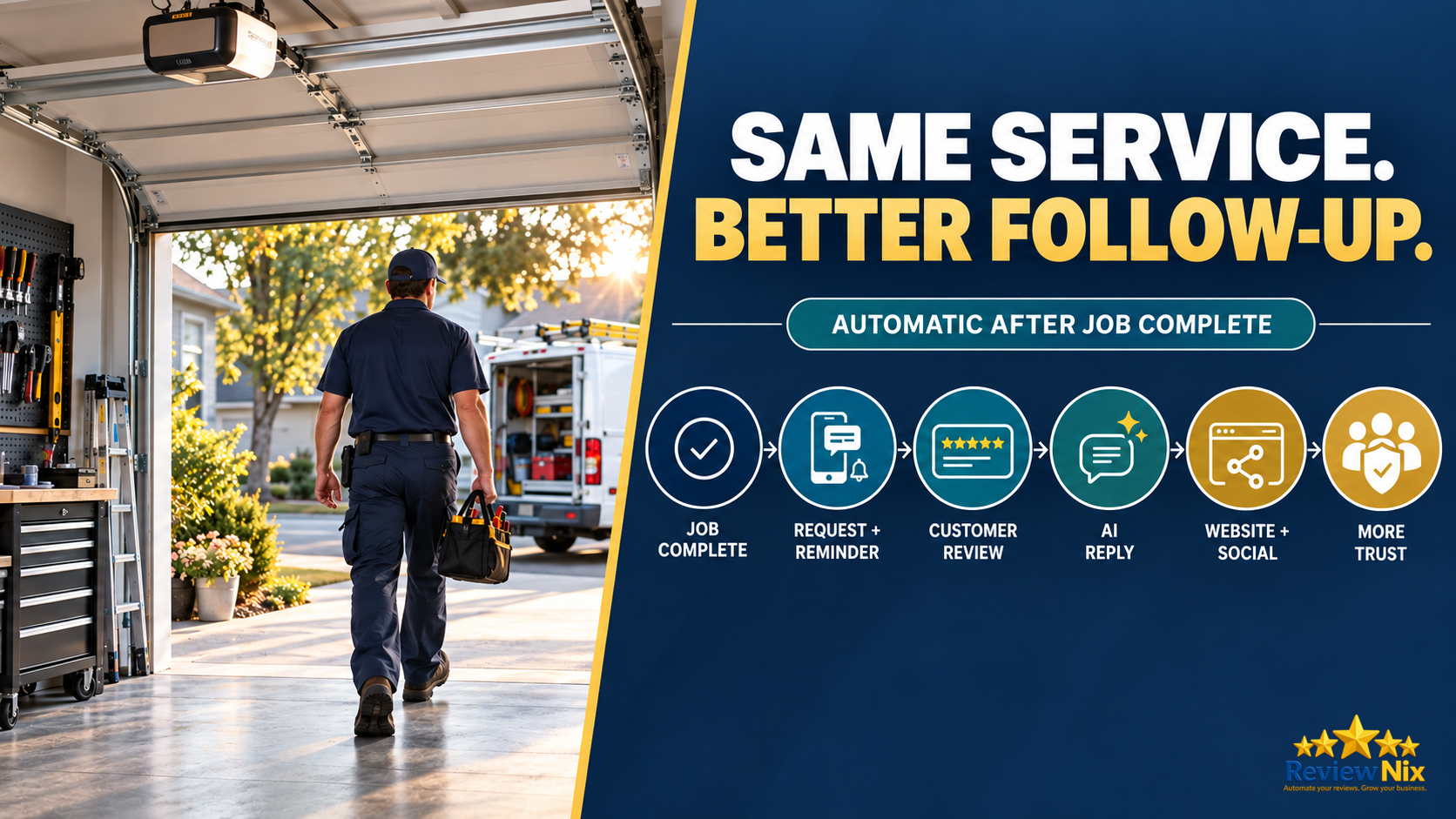
You can run this follow-up by hand, but you should not have to remember, chase customers, send links, manage reminders, monitor reviews, and prepare replies every day.
The Houston shop proved the work on the door was not the bottleneck. The bottleneck was the after-job ask. An owner can copy the templates here, mark every job complete, and text the link from a phone. That works until the fourth ticket, the after-hours spring, and the Saturday install land on the same week. Then the ask slips again.
Guided onboarding connects the Google Business Profile and sets the pieces you would otherwise keep in a notebook: the completed-service trigger, the channels (SMS, email, or WhatsApp), the templates, the timing, reminder limits, the direct review link, a QR code for invoices and trucks, and the stop rules. You set those once. You do not rebuild them every Monday.
After launch, ReviewNix sends neutral review requests through the channel you chose and handles respectful follow-up reminders. The message stays an honest ask for genuine feedback. It does not pitch a rating. It does not offer a discount. It does not sort customers into "send to Google" and "keep quiet."
The workflow stops or suppresses extra outreach when a review is completed, when someone opts out, or when an exception rule fires. Wrong number, job not actually finished, customer asked not to be contacted — those should never get another nudge. Quiet hours belong in the same setup.
The dashboard keeps requests, clicks, and new reviews in one place. AI-assisted reply drafts help you answer faster and stay professional. A person still owns the send. The draft is there so "under 24 hours" does not depend on a blank screen at 10 p.m.
ReviewNix automates legitimate requests for genuine feedback. It does not create fake reviews. It does not pay for ratings. It does not gate. It does not selectively solicit. It does not guarantee a rating, a review count, or a ranking. The Houston numbers in this article are one early-access client. Your job volume and your customers will write their own story.
Set it up once. Let ReviewNix handle the follow-up.
FAQ
These are the five questions garage-door operators ask after they see a 45-day review jump — how many reviews they need, whether discounts are allowed, how fast to reply, whether to chase Yelp, and when to send the ask.
How many Google reviews does a garage-door company need?
You need enough recent, honest Google reviews that a homeowner can trust you next to nearby shops, not a magic total. Velocity and recency beat a vanity number that sat still for a year. This Houston shop started at 38 and added 21 reviews in 45 days. That did not complete a requirement. It showed the profile was alive. We will not name a guaranteed count, rating, or rank. Compare your last month of new reviews with the shops a caller would also open. If yours look older and thinner, the gap is follow-up.
Can I offer a discount for a Google review?
No. Google does not allow payment, discounts, free goods, or free services in exchange for posting, changing, or removing a review. An incentive can get reviews pulled and can restrict the profile. Gating is also out: do not send only happy customers to Google and park complaints on a private form. Ask every completed job the same way. Ask for an honest review. Skip the coupon and skip any line that says to write only if they loved it. If someone wants a price break, put it on the invoice, not on the review.
How fast should I reply to Google reviews?
Reply under 24 hours. That is the bar this Houston shop hit, and it is the habit callers notice when they read the last few notes before they dial. Thank the reviewer. Mention the work if they named it. For a hard review, stay calm, take the fix to a phone call or email, and do not argue in public. Do not wait for Friday office time. Assign one owner. Use alerts. Drafts can help, but a person should still send the reply. Speed without a fight is the goal.
Should garage-door companies ask for Yelp too?
Google is the first stop for a broken door, so put the after-job ask on your Google Business Profile, not on a stack of portals in the first text. Extra sites split attention and lower the chance anyone finishes a review. If Yelp already sends you work, keep the listing accurate and reply there. Do not make Yelp compete with the same-day Google link. One honest ask, one direct Google link, then stop when they opt out or complete it. Treat other sites as secondary, not as a second homework assignment for the customer.
What's the best time to ask after a garage-door job?
Ask the same day, after the technician has left and the door is working. That completed-service window is when the job is still the story. Do not pitch in the driveway while you wait on a signature. Do not wait a week until the door is just part of the house again. A short SMS with a direct Google review link fits the moment. A QR on the invoice can back it up for someone who prefers a laptop at night. One respectful reminder is optional. The first ask should not wait for weekend admin.
Follow-up moved this Houston garage-door profile: 38 to 59 reviews in 45 days, 15.9% conversion, 4.6 to 4.7, replies under 24 hours, GBP calls +41.9%, website clicks +44.4%. Copy the same-day ask. Keep it honest.