Google Reviews for Flooring Companies
Google Reviews for Flooring Companies
The work can be complete and the customer can be satisfied, yet the review request still never goes out. That gap is rarely a motivation problem. It is an operating-system problem. When flooring company review program depends on somebody remembering at the end of a busy day, follow-up becomes inconsistent, reporting becomes vague and owners start chasing employees instead of improving the process.
This guide shows local-business owners how to build a neutral, policy-conscious workflow around google reviews for flooring companies. The aim is not to manufacture praise or promise a ranking. It is to make honest feedback easier for real customers, route sensitive situations to a person and give management a small set of numbers it can trust.
The short answer
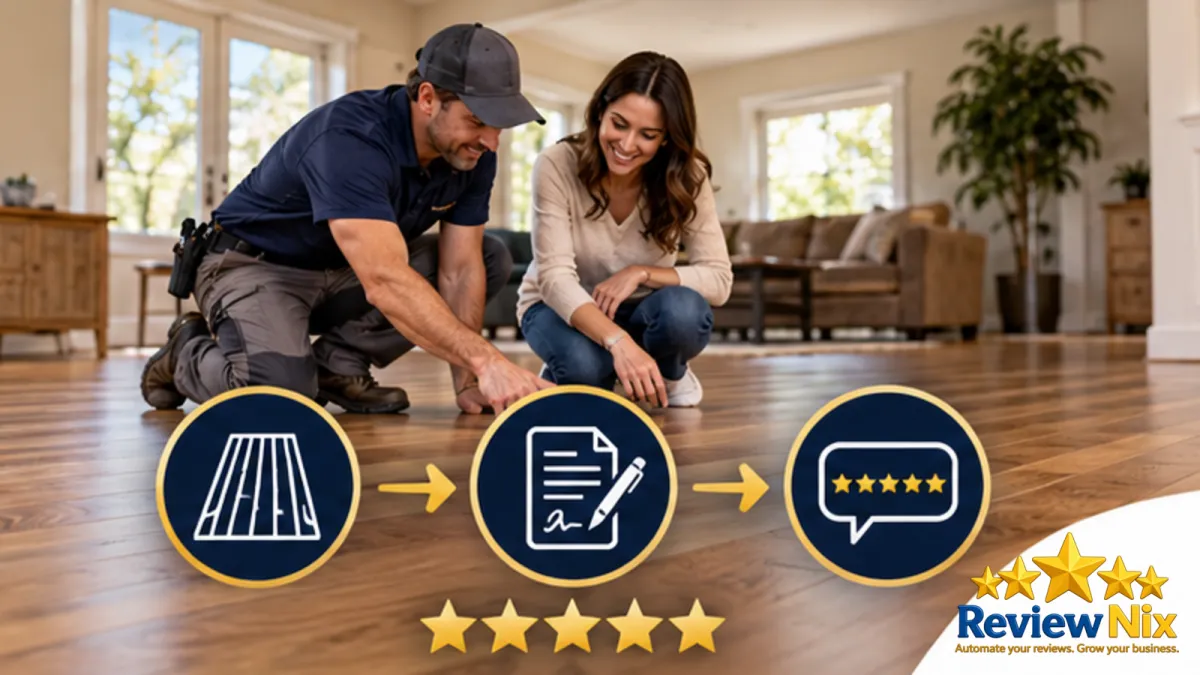
Make the request a dependable part of the flooring company customer journey. Start with one observable trigger: after the final walkthrough, cleanup and punch-list completion. From that event, send one brief message with the correct location-specific Google review link. Suppress the request when there is an open complaint, a callback, a privacy concern or an opt-out. If no review appears, allow no more than one polite reminder. Give one person ownership of public replies and review the results every week.
Google allows businesses to ask customers for reviews that reflect genuine experiences. Google also prohibits paid reviews, incentives, rating manipulation and selective solicitation of positive feedback. That means the safest workflow asks eligible customers neutrally; it does not ask for “five stars,” hide the review link from unhappy customers or reward the customer for posting.
Why the request keeps falling through
Most local companies already know reviews matter. Their failure point is the handoff between service delivery and customer follow-up. The technician closes a ticket, the dispatcher starts the next call, the front desk handles a reschedule and the owner assumes someone sent the link. At 5 p.m., the job is complete but no system owns the request.
Manual asking also produces uneven customer experiences. One employee may make a gracious, neutral request. Another may say, “Please leave us five stars and mention my name.” A third may forget completely. The business cannot improve what it does not standardize. A written eligibility rule, approved message and fixed reminder cap turn the ask into a process rather than a personality test.
The goal is not to remove humans. It is to reserve human attention for the moments that require judgment: a complaint, a disputed invoice, a sensitive health or legal detail, a suspected fake review or a public response that could make matters worse.
Set the policy before choosing software
Write the rule in plain language before configuring any automation. Define which completed interactions are eligible, which conditions pause a request and who can restart it. Include customers with genuine experiences regardless of whether staff believe the feedback will be positive. Selective asking based on an internal satisfaction score can become review gating.
Your policy should also cover contact permission, quiet hours, opt-outs, multiple locations and repeat customers. A customer should not receive a request from the wrong branch, and a recurring customer should not get the same message after every visit. The software should enforce those decisions, not invent them.
The compliance baseline
Ask for honest feedback, not a predetermined rating. Do not offer money, discounts, gifts or services for posting, revising or removing a review. Do not route only happy customers to Google while sending others to a private form. Keep records of the approved message, eligibility rule and opt-out process.
A five-step operating workflow
- Step 1: Define the eligible completion event. Write the condition so two employees would make the same decision. For this topic, the practical trigger is after the final walkthrough, cleanup and punch-list completion. A vague status such as “probably finished” cannot support dependable follow-up.
- Step 2: Verify the correct customer and location. Match the customer record to the exact Business Profile location and confirm that the customer actually experienced the service. Shared databases and duplicate listings are common sources of bad sends.
- Step 3: Send one neutral direct-link request. Keep the message short, conversational and rating-neutral. The direct link should reduce navigation steps, but the customer remains free to write any honest feedback or none at all.
- Step 4: Pause on complaints, callbacks or opt-outs. Stop automation when a reply, complaint, callback, opt-out or data mismatch appears. A pause is an operating safeguard, not a hidden filter that permanently excludes negative customers.
- Step 5: Assign a named owner for replies and weekly reporting. One accountable owner should review delivery failures, public responses and weekly metrics. Ownership turns scattered activity into a process the business can audit and improve.
Write a request a customer can understand in seconds
A useful message identifies the business, connects the request to the completed interaction and offers one direct action. It does not explain your SEO goals. It does not tell the customer what rating to choose. It does not create urgency that does not exist.
Hi [First name], thank you for choosing [Business] for [service]. If you have a moment, you can share honest feedback on Google here: [direct review link]. Thank you.
If a reminder is appropriate, keep it lighter than the first request:
Just a quick follow-up from [Business]. If you would still like to share feedback about your recent service, here is the Google link: [direct review link]. No need to reply if you have already posted.
Test every link from a phone that is not signed in as the profile owner. Confirm that it points to the intended location. Keep tracking parameters and redirects simple. If the link fails, the copy around it cannot rescue the workflow.
Timing: send after the result, not merely after the transaction
The right trigger is the moment the customer can fairly judge the work. For some services that is a closed ticket. For longer projects it may be a final walkthrough, follow-up visit or signed punch list. For recurring service it may be the first meaningful milestone rather than every invoice.
Same-day requests are often operationally convenient because the details are still fresh, but “same day” is not a universal guarantee of performance. A business should compare a consistent same-day window with a next-morning window, respect local messaging rules and choose the timing that fits its customers. The important part is consistency and relevance, not an unsupported claim that one hour always wins.
Adapt the workflow to flooring contractors
For a flooring company, the strongest trigger is after the final walkthrough, cleanup and punch-list completion. The customer can then evaluate finished surfaces, clean transitions and resolved touchups. The request should never jump ahead to after material selection or deposit.
The main operating risk is that material delays and acclimation issues must not trigger a premature request. Build that condition into staff training and automation rules. The wording can remain simple, but the eligibility logic should reflect how the service is actually delivered.
Build exception paths before turning on automation
A single straight-line automation is easy to draw and dangerous to operate. Add branches for canceled work, refunds, callbacks, warranty visits, duplicate contacts and open complaints. These branches are not a method for screening out negative opinions. They prevent an obviously mistimed request while the business is still working on the customer’s issue. Once the service interaction is genuinely complete, the normal neutral request rule can apply.
Assign a named owner to each exception. “The office” is not an owner. Use a person or role with a response deadline, access to the job record and authority to move the issue forward. Document why a request was paused and when it was released.
Measure the funnel without pretending you control Google
Track four basic counts in the same reporting window: eligible completed interactions, delivered requests, link clicks when your system can measure them and newly published reviews. The most useful operating rate is published reviews divided by delivered requests. It is a directional measure because some people may review without clicking the tracked link, and some reviews may be delayed or filtered by Google.
Keep the denominator visible. “We gained 20 reviews” means something different after 80 delivered requests than after 800. Segment by location, service line and trigger only when the sample is large enough to be useful. Do not rank employees by named reviews or create quotas that pressure customers.
Also watch reply time, recurring complaint themes and the percentage of requests paused for open issues. These measures connect reputation work to operations. A falling rating is not only a marketing problem; it may be an early signal that scheduling, communication, cleanup or billing needs attention.
Common mistakes that weaken trust
- After material selection or deposit. This puts the request ahead of the customer’s ability to judge the result and can make the interaction feel pressured or irrelevant.
- Asking for a five-star rating. Google permits neutral requests for genuine feedback; prescribing the rating changes the request from feedback collection to rating influence.
- Offering an incentive. Payments, discounts, free goods or services tied to a review create policy risk and weaken the credibility of the feedback.
- Letting every employee improvise. Variation makes training, measurement and compliance difficult. Give the team approved language and a defined exception path.
- Continuing reminders after a problem is reported. A customer who reports a problem needs resolution, not another automated prompt. Stop the sequence and assign a human owner.
How ReviewNix puts the follow-up on autopilot
ReviewNix is designed to make the post-service handoff consistent: one completion trigger, the correct location-specific review destination, an approved message, a capped reminder and a named owner for replies. The value is operational clarity. The system does not need to promise a ranking or manufacture a perfect rating to be useful.
Start by checking the gaps in your current process with the free Reputation Score. If you are still mapping the workflow, use the free Review Growth Playbook. Teams ready to connect completed jobs to automatic requests can review the ReviewNix trial form. These links serve different reader intents; choose the one that matches the next real decision.
A 30-day implementation plan
Week 1: map the handoff
List every status that staff currently interpret as “done.” Pick one status that is reliable enough to trigger the request, and document exclusions. Verify every Google Business Profile location and direct review link. Review contact-permission and opt-out requirements with the appropriate adviser for your jurisdiction and industry.
Week 2: run a controlled pilot
Start with one location or service line. Send the approved message only after eligible completed work. Test the customer experience on common mobile devices. Keep a log of wrong numbers, duplicate contacts, open issues and replies that need human attention.
Week 3: fix the exceptions
Review every suppressed or failed request. Most automation problems are data problems: the wrong location, an unreliable job status, a shared family number or a missing opt-out. Correct the source process before adding more messages.
Week 4: review outcomes
Compare eligible jobs, delivered messages, clicks and published reviews. Read the feedback for operating themes. Confirm that the reminder cap worked and that sensitive responses were reviewed by a person. Decide whether to expand, revise or pause based on evidence.
Owner’s weekly review checklist
- Were requests sent only after eligible completed interactions?
- Did any customer receive a request for the wrong location?
- Were opt-outs and complaint replies handled promptly?
- Did the message remain neutral, with no five-star language or incentive?
- Were low ratings and sensitive reviews routed to a person?
- Are delivered requests, clicks and published reviews reported in the same date window?
- What service problem appeared more than once in new feedback?
- What single workflow change should be tested next week?
Frequently asked questions
Can a business ask customers for Google reviews?
Yes. Google’s published guidance allows businesses to remind customers to leave reviews, including through a review link or QR code, as long as the feedback reflects a genuine experience and the business does not use incentives or rating manipulation.
Should the message ask for five stars?
No. Ask for honest feedback without suggesting a score or specific wording. Neutral language is easier to train, defend and use consistently.
How many reminders should be sent?
A conservative workflow uses one initial request and no more than one polite reminder. Stop immediately after an opt-out, complaint, reply or known review. The right cap also depends on applicable messaging rules.
Should unhappy customers be sent somewhere else?
Do not use a satisfaction question to decide who gets the public review link. That is review gating. Handle service recovery as an operational process, then apply the same neutral eligibility rule.
Does this guarantee a higher local ranking?
No. Google says local results are mainly based on relevance, distance and prominence, and there is no way to request or pay for a better ranking. Reviews are one part of a broader local presence.
What should the owner measure for flooring company review program?
Use eligible interactions, delivered requests, clicks when available, newly published reviews, reply time and recurring complaint themes. Keep every metric in the same date window and show the denominator.
Document the standard so the process survives a busy week
A workflow is not complete until a new employee can follow it without guessing. Keep a one-page operating standard that names the trigger, exclusions, approved message, reminder limit, reply owner and reporting cadence. Add screenshots of the correct location-specific link and examples of events that should pause the sequence.
Review the document after the first week, after any software change and whenever customers report a confusing message. Version the approved copy so the team knows which wording is current. If a platform policy, privacy requirement or messaging rule changes, update the standard before restarting the automation.
Use quality control, not pressure
Managers should audit whether the process was followed, not whether every customer left a high rating. Check a small sample of completed interactions against sent requests. Look for wrong-location links, duplicate messages, missing opt-outs and requests sent while a callback was open. Coach the process gap without creating review quotas tied to employee compensation or names in public reviews.
Turn feedback into an operating meeting
Once a week, group new reviews by theme: communication, arrival time, workmanship, cleanliness, billing, scheduling and recovery. Choose one theme the team can influence. Assign an owner and a date for the process change. The review program then becomes more than an acquisition tactic; it becomes a compact voice-of-customer system.
For google reviews for flooring companies, the most important discipline is still the same: the business controls its trigger, message, routing and response. It does not control the customer’s opinion or the platform’s publication decision.
Keep a small change log beside the weekly report. Note the date, the workflow adjustment, the location affected and the reason for the change. This prevents the team from altering timing, copy and eligibility at the same time, which would make the result difficult to interpret. One controlled change per reporting cycle produces clearer learning and a safer rollout.
Make follow-up part of finishing the job
Make the request a dependable part of the flooring company customer journey. The durable approach is simple: define the completion event, ask every eligible customer neutrally, use one direct link, cap reminders, protect privacy and give a person responsibility for exceptions and replies. That system will not control what a customer writes or what Google publishes. It will make the business’s own follow-up consistent, measurable and easier to improve.
Next step: Check your current process with the free ReviewNix Reputation Score.
Sources and editorial notes
- Google Business Profile Help: Tips to get more reviews
- Google Maps User Generated Content Policy: Prohibited and restricted content
Editorial note: Platform policies and legal requirements can change. Verify current Google, FTC, privacy, messaging and professional rules before publication or implementation. This article provides operational education, not legal advice.