Dental Review Request System: Automate Google Reviews
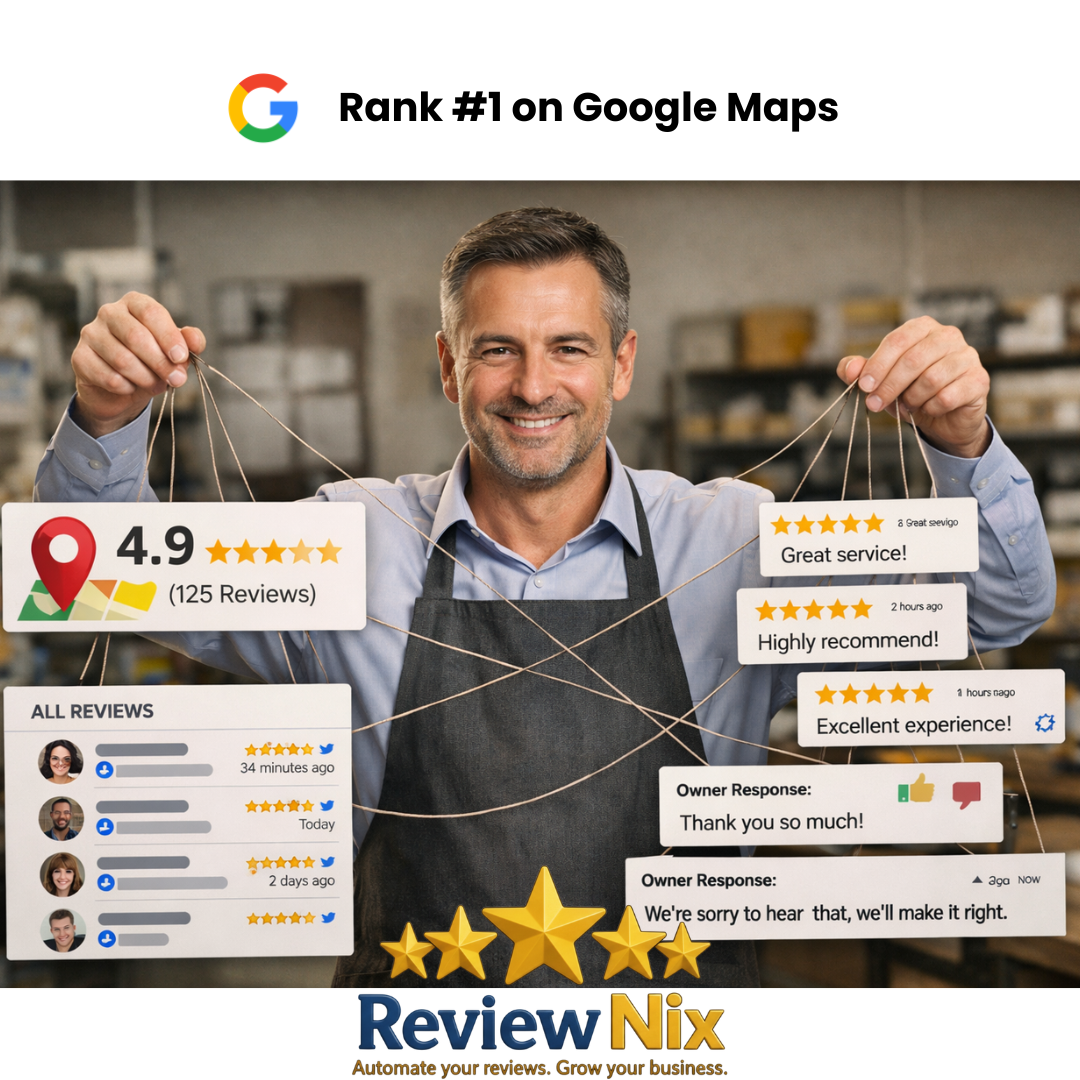
The fastest path to more Google reviews for a dental practice is simple: send a short, compliant review request after every completed visit—automatically—so the front desk never has to remember.
Your dental practice delivers excellent care. Patients leave happy. But when a new patient searches "dentist near me" on Google, they see a competitor with 340 reviews ranked above you — and you have 47. That competitor books the appointment.
This is not a quality problem. It's a systems problem. Most dental practices rely on front-desk staff to remember to ask patients for reviews, or they send a generic email blast days after the appointment. Both approaches fail. The solution is a review automation system built specifically for how dental practices operate.
This guide explains exactly why manual review collection breaks down in dental settings, what a proper automated system looks like, and how to build one that generates a consistent flow of genuine Google reviews — without adding burden to your team or crossing any compliance lines.
Why Dental Practices Struggle to Get Google Reviews
The dental industry has a structural problem with review collection that most other service businesses don't face.
The post-appointment window is extremely short. Research on customer review behavior shows that people are most likely to leave a review within 30–60 minutes of a positive service experience. In a dental practice, that window closes the moment the patient walks out the door. They're rinsing with mouthwash, scheduling their next cleaning, and thinking about getting back to work — not thinking about Google reviews.
Front-desk staff are already at capacity. Check-ins, insurance verification, appointment reminders, phone calls, billing questions — asking each departing patient for a review is one more task that gets deprioritized under pressure. Studies of dental office workflows show that manual review requests happen consistently only about 20% of the time they're intended to.
There's also a HIPAA-related hesitation. Many dental practices avoid automated patient communication out of concern for compliance. This hesitation is understandable but often misapplied. Review requests don't ask patients to disclose health information — they invite patients to share their experience. When structured correctly, automated review requests are fully HIPAA-compatible.
The result: practices with 4.8-star patient satisfaction scores routinely have fewer than 100 Google reviews, while competitors with equivalent care have 300+ reviews and dominate local search.
Why Google Reviews Matter More in Dentistry Than Almost Any Other Field
Local search is the primary patient acquisition channel for dental practices. According to Google's own research, 76% of people who search for a local service visit a business within 24 hours. For dental practices, the decision is almost entirely review-driven — new patients can't evaluate clinical skill before their first visit, so they rely on social proof.
Google's local ranking algorithm weighs three factors: relevance, distance, and prominence. Review count and review velocity (how consistently new reviews come in) are direct inputs to prominence. A practice with 50 reviews and a 4.2-star rating will almost always rank below a practice with 200 reviews and a 4.6-star rating, even at the same distance.
The math is stark: if your practice sees 20 patients per day and converts just 5% of them into reviewers, that's one new Google review per day — approximately 30 per month. Most dental practices are at fewer than 5 per month because they have no system.
How Review Automation for Dentists Actually Works (Step-by-Step)
A properly built review automation system for dental practices runs on four steps — all triggered automatically after each appointment, with zero manual input from your team.
Step 1: Appointment completion trigger. The system connects to your scheduling software or practice management system (Dentrix, Eaglesoft, Open Dental, etc.) or receives a simple webhook when an appointment is marked complete. This triggers the review sequence.
Step 2: Personalized SMS sent within 30 minutes. An SMS is sent to the patient's mobile number. The message is personalized with their first name, references their appointment type (cleaning, crown, whitening — not their diagnosis), and includes a direct link to your Google Business Profile review page. Short, warm, direct. Industry benchmarks show SMS review requests in dental practices achieve 3–5x higher open and click rates than email alone.
Step 3: Email follow-up at 24 hours (if no review left). If the patient hasn't clicked through to leave a review, a follow-up email is sent the next day. This is not a reminder that nags — it's a second genuine invitation, often with a short note from the dentist. This step alone typically captures an additional 15–20% of responses that the SMS missed.
Step 4: Feedback collection for non-respondents. Patients who don't engage with either touchpoint receive a brief satisfaction survey after 72 hours. This captures internal feedback that helps the practice improve — and ensures that only patients who had a positive experience are guided toward public Google reviews. This is legitimate, compliant, and effective.
The entire sequence requires no manual action from front-desk staff after the initial setup.
Related: Google reviews for optometrists.
Related: HIPAA and Google reviews for dentists, dental Google review request scripts and Google reviews for chiropractors.
The Most Common Mistakes Dental Practices Make With Review Requests
Asking at checkout verbally. This puts staff in an awkward position and produces inconsistent results. Patients say "of course!" and then forget entirely by the time they get to their car.
Sending review requests from a generic email. Emails from "[email protected]" are ignored. Personalized messages from a named sender — ideally the dentist — get 40–60% higher response rates.
Waiting more than 2 hours after the appointment. Every hour beyond the post-appointment window reduces the likelihood of a review by approximately 10–15%. Same-day delivery is non-negotiable.
Sending the same message to every patient. A cleaning patient and an implant patient had very different experiences. Generic messaging misses the emotional relevance that drives responses.
Stopping after one touchpoint. Most practices send one request and stop. A two-touch sequence (SMS + email) with a 24-hour gap typically doubles response rates compared to a single message.
Want to see where your practice's review system stands right now? Get your free Reputation Score — it shows your current review velocity, response rate, and Google Business Profile health in 60 seconds: → https://reviewnix.com/reputation_score
Real-World Result: What Consistent Review Automation Looks Like in Practice
Consider what a home services company experienced after implementing ReviewNix's automated system: starting with a review base that wasn't generating meaningful new volume, they built a consistent daily flow of genuine customer reviews — improving their Google Business Profile authority and local search position over 60 days. The same system applies directly to dental practices, where the appointment-based workflow is even better suited to automation than most service businesses.
For a dental practice seeing 400 patients per month, a 5% conversion rate means 20 new Google reviews per month. At 10%, that's 40 per month. Within six months, a practice that had 80 reviews could have 200–300 — a level that materially shifts local search ranking and new patient inquiries.
The practices that win local search in competitive dental markets are not the ones with the best clinical marketing. They're the ones with the most consistent, systematic approach to building their online reputation. That's a process problem, and it has a process solution.
Frequently Asked Questions — Review Automation for Dentists
Is automated review collection HIPAA-compliant for dental practices? Yes, when structured correctly. Review requests invite patients to share their experience publicly — they do not ask patients to disclose or confirm any protected health information (PHI). The request should reference the appointment in general terms ("your recent visit") rather than specific treatments or diagnoses. A compliant review automation platform will never include clinical details in outbound messages.
How many Google reviews does a dental practice need to rank competitively? There's no single threshold, but in most mid-sized U.S. markets, practices in the top 3 of Google Maps (the "Local Pack") have 150–400+ reviews with a rating above 4.5 stars. Review velocity — how consistently new reviews arrive — matters as much as total count. A practice adding 15–20 reviews per month will outpace one with 300 total reviews that adds 2 per month.
Can I automate review requests without connecting my practice management software? Yes. While a direct integration with Dentrix, Eaglesoft, or Open Dental creates the smoothest workflow, review automation can also be triggered manually (by uploading a daily patient list) or via a simple webhook. Many practices start with a lightweight manual trigger and automate more deeply over time.
What's the best time to send a review request to a dental patient? Within 30–60 minutes of appointment completion is optimal. If that's not possible, same-day delivery is the goal. Tuesday through Thursday, mid-morning or late afternoon sends typically outperform Monday mornings and Friday afternoons. Avoid sending after 8 PM — open rates drop significantly.
Conclusion
Dental practices don't lose new patients because of bad clinical care. They lose them because their online reputation doesn't reflect the quality of that care — and the root cause is almost always a broken or absent review collection system.
A properly built review automation system removes the reliance on staff memory, catches patients in the right window, and creates a consistent flow of genuine Google reviews that compound over time. It doesn't require adding headcount, and it doesn't require changing how you practice dentistry.
The first step is knowing exactly where your practice stands today.
See your Reputation Score in 60 seconds — review velocity, GBP health, and what's holding your practice back from ranking higher: → https://reviewnix.com/reputation_score
Ready to build the review system for your dental practice? Prefer a guided setup? Start here: → https://reviewnix.com/formpage